Case Study (04) · Self-directed Concept
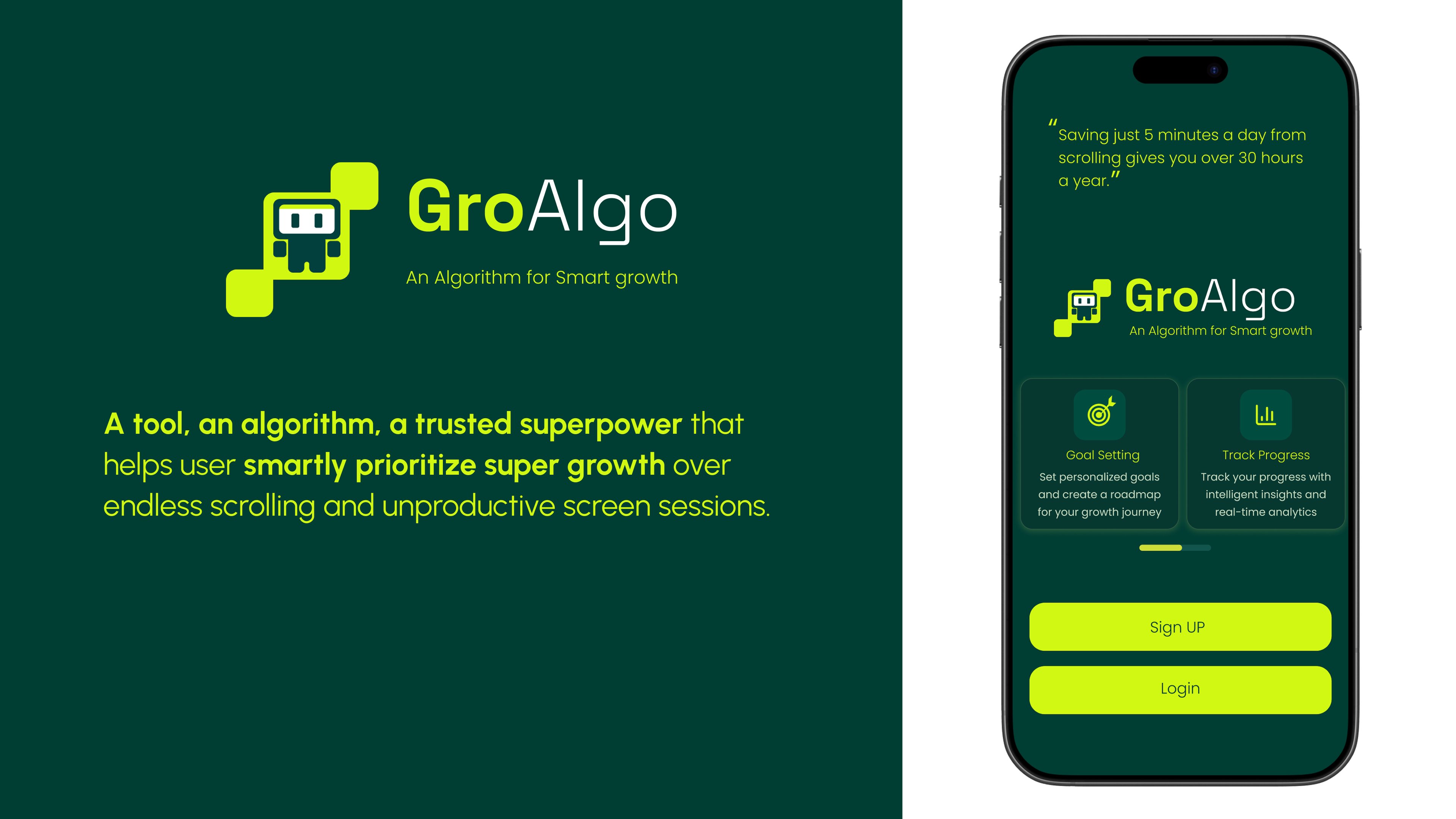
A self-directed concept that turns the attention-capture playbook of social media inward — reclaiming the hours lost to scrolling.
Solo end-to-end · Research to validation · Concept project
Assumption & Hypothesis
People lose hours daily to endless scrolling — yet no tool helps reclaim that time for personal growth.
If a device pushes its user toward growth instead of trapping them in the scroll, they’ll achieve more.
Constraints & My Role
Design Approach
GroAlgo runs on the Hooked Model — Trigger, Action, Reward, Investment — the same loop Nir Eyal described as the engine behind social feeds. The twist: each loop pulls attention out of the scroll, not into it.
Voice of the Users
Conversations with people losing time to the scroll surfaced two root frustrations: no support to break it, and no personalization from the tools that tried.
“Every morning I wake with the plan of doing something great, but the social media distractions keep pushing my goals away.”
Lack of support
“I know what I want to do, but there is no platform that guides me through the process.”
Lack of personalization
“Other tools just give reminders and alerts that I set myself — nothing insightful that actually encourages me.”
Lack of personalization
Competitor Analysis
Two apps set the bounds of the field. Habitica gamifies habits with real engagement mechanics, but its rewards are virtual. Strava tracks fitness brilliantly, but speaks only to athletes — not to someone saving for a house or pivoting careers.
Both miss the same thing: personalization beyond a single vertical. Neither asks who you are or what “growth” means to you. That gap is where GroAlgo lives.
Users & Persona
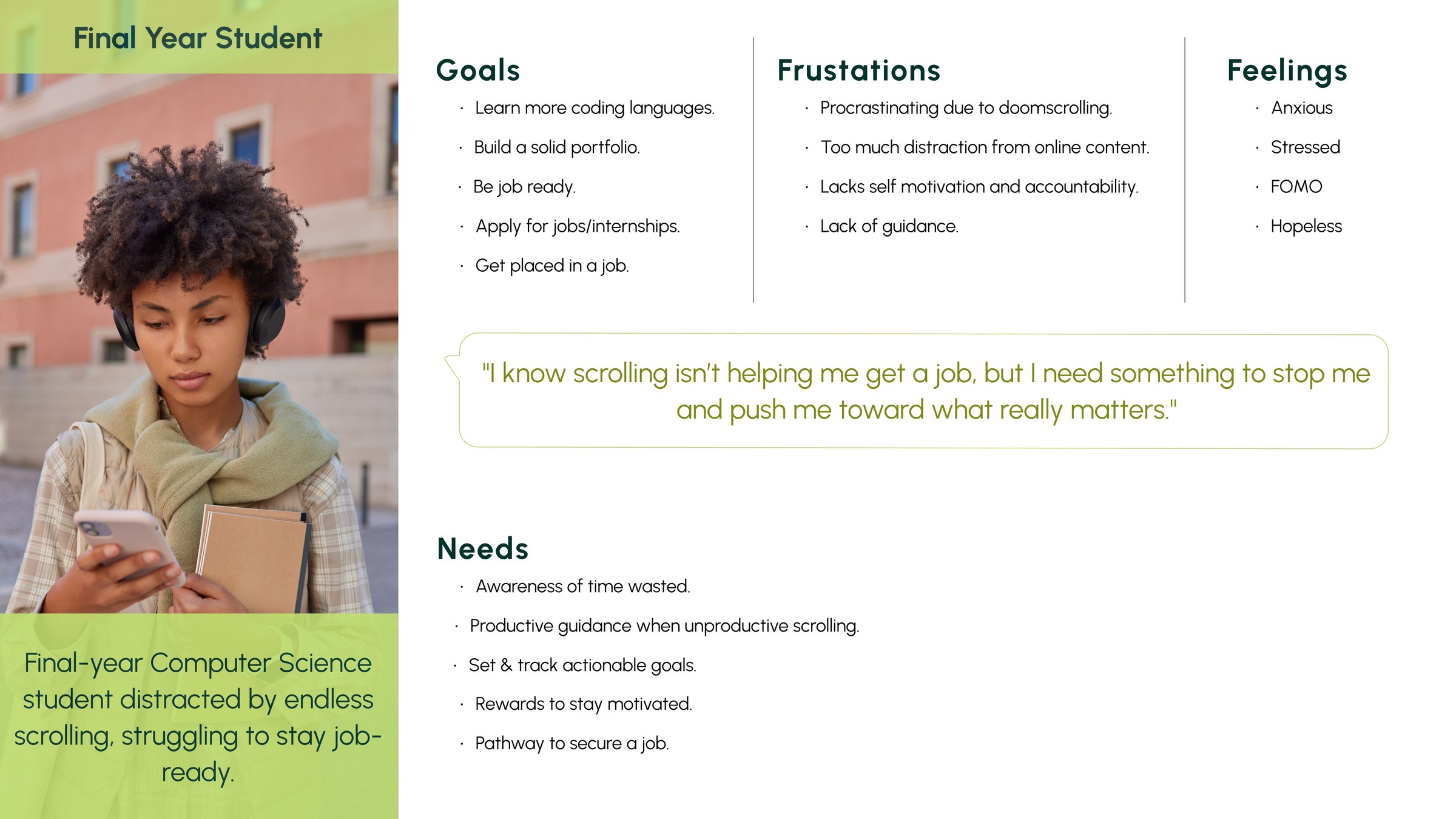
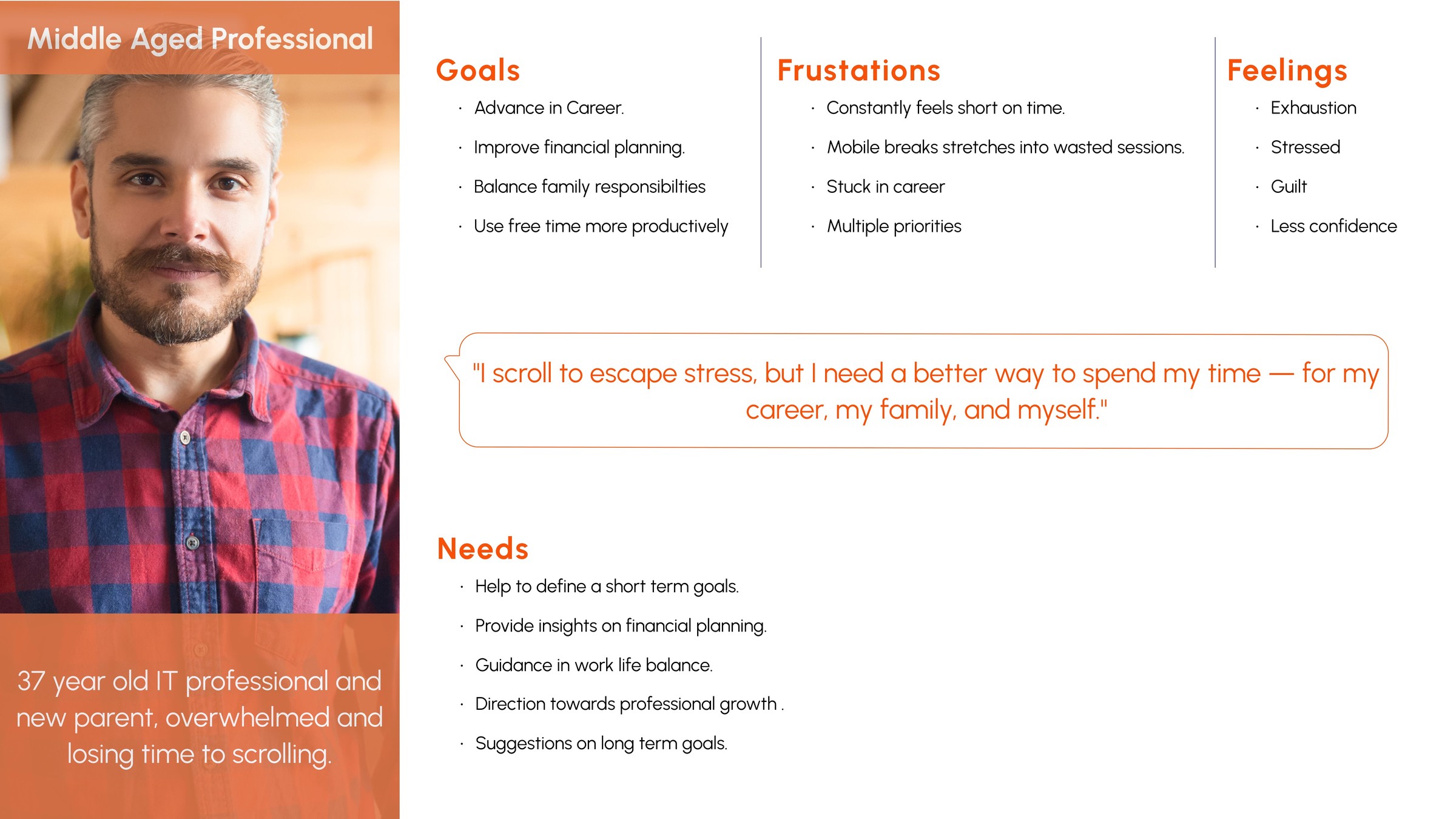
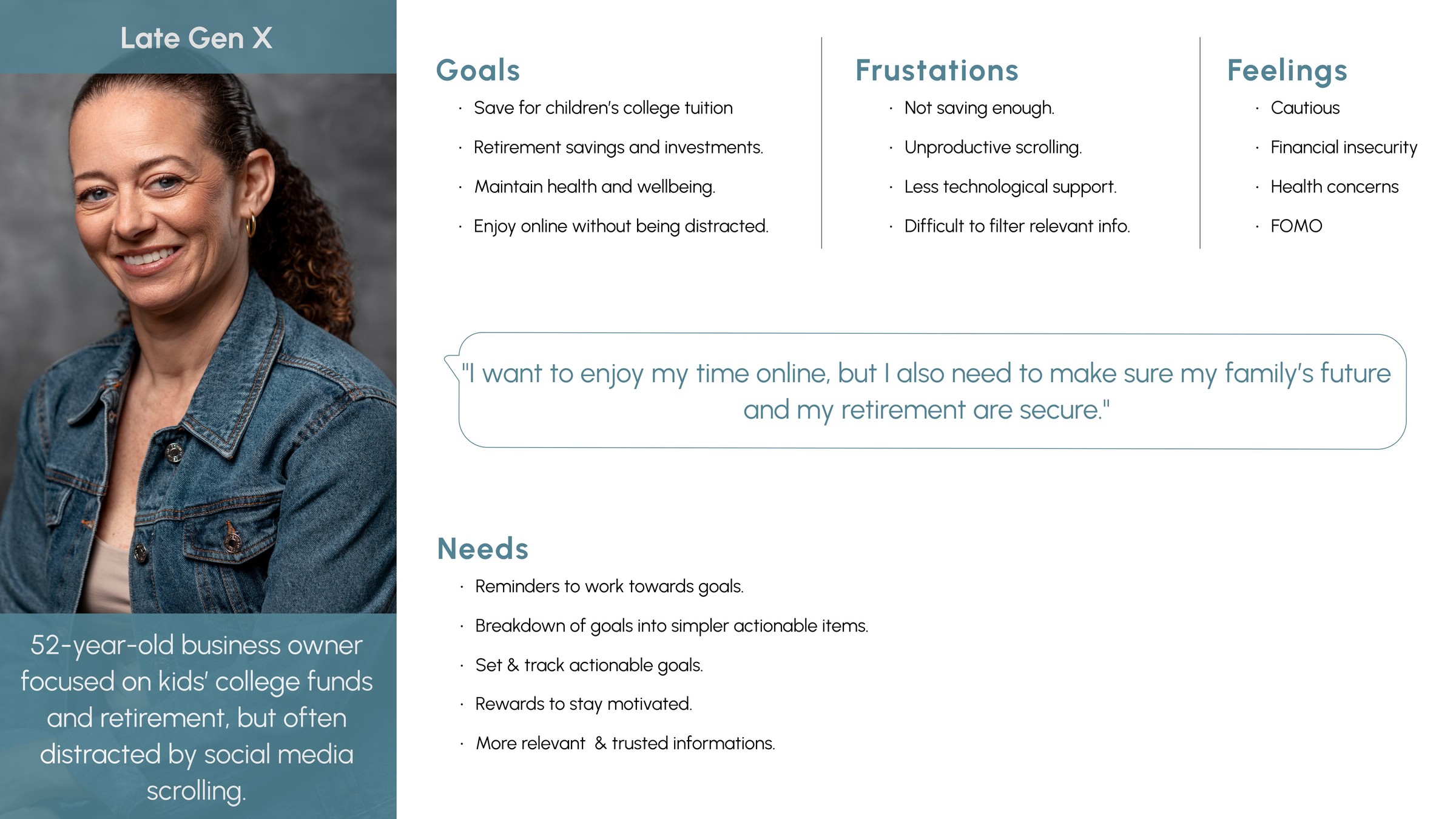
GroAlgo’s audience spans three generations whose goals diverge but whose daily frustration converges — time lost to the scroll. Gen Z wants to stay job-ready. Millennials balance career pivots, savings, and parenting. Gen X focuses on retirement and their kids’ futures. The product had to honour those differences while still feeling like one tool.
Journey Map
A single closed loop: set a goal, link the distracting apps, and every unproductive minute becomes an opening for a soft nudge — toward a goal-aligned action, rewarded on completion.
Inside the Product
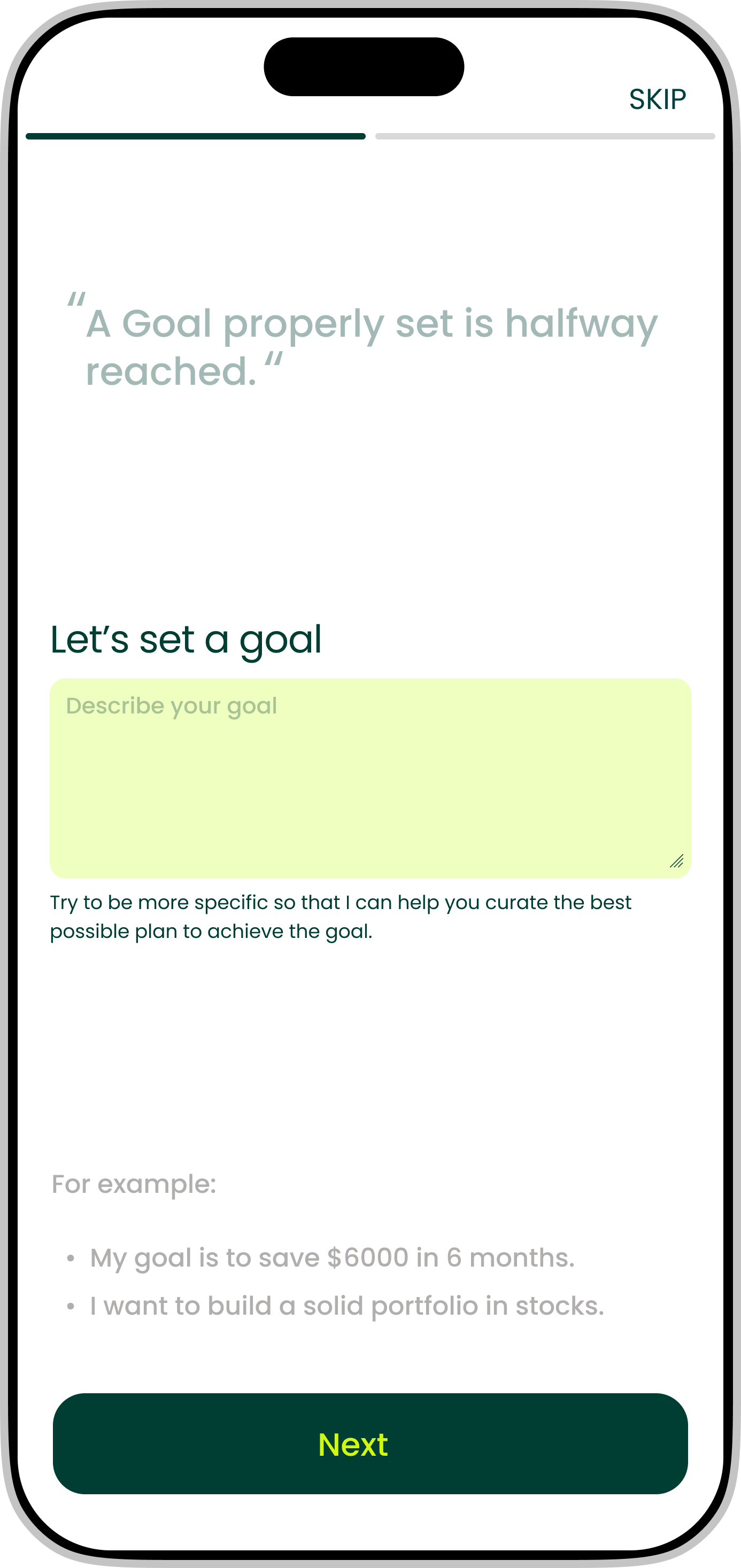
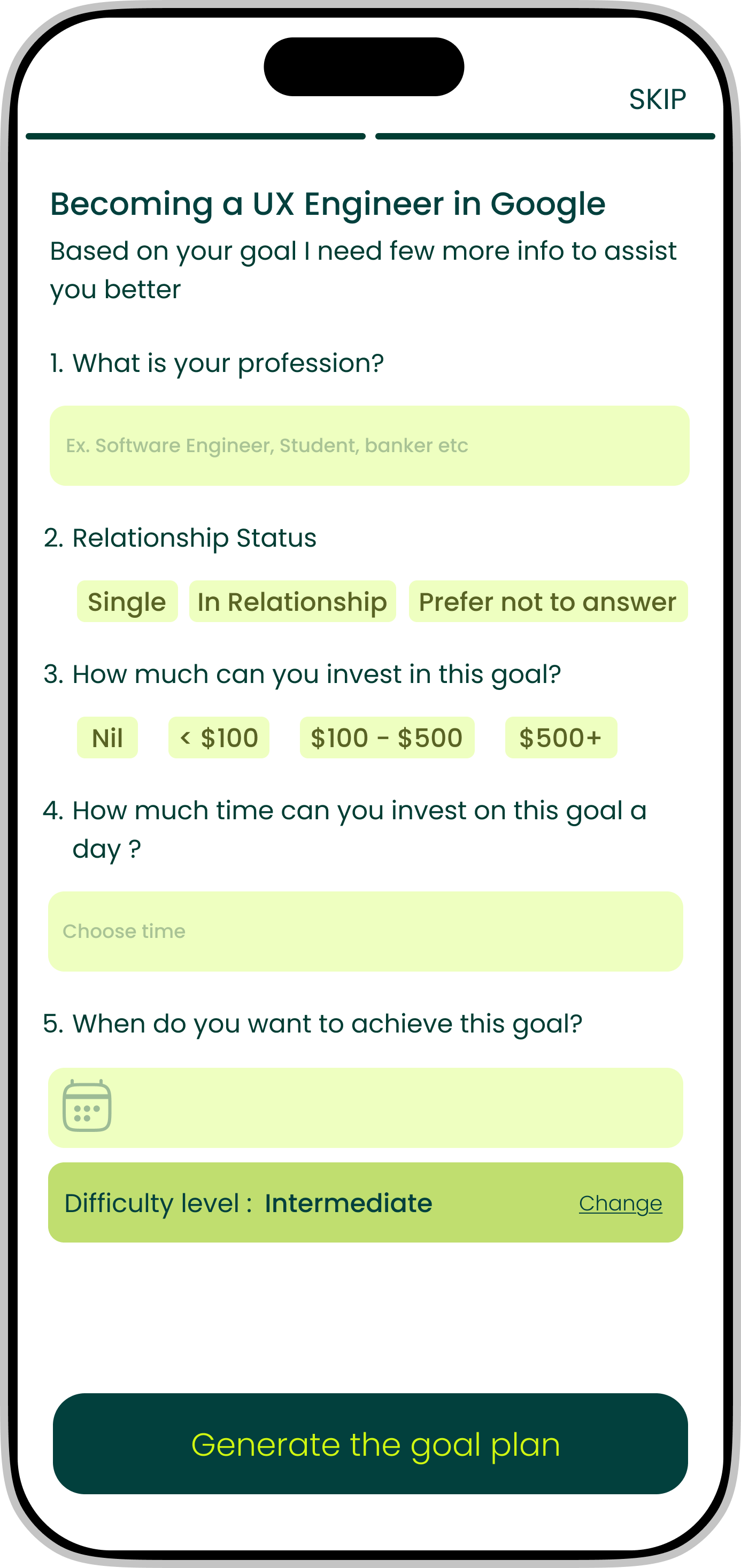
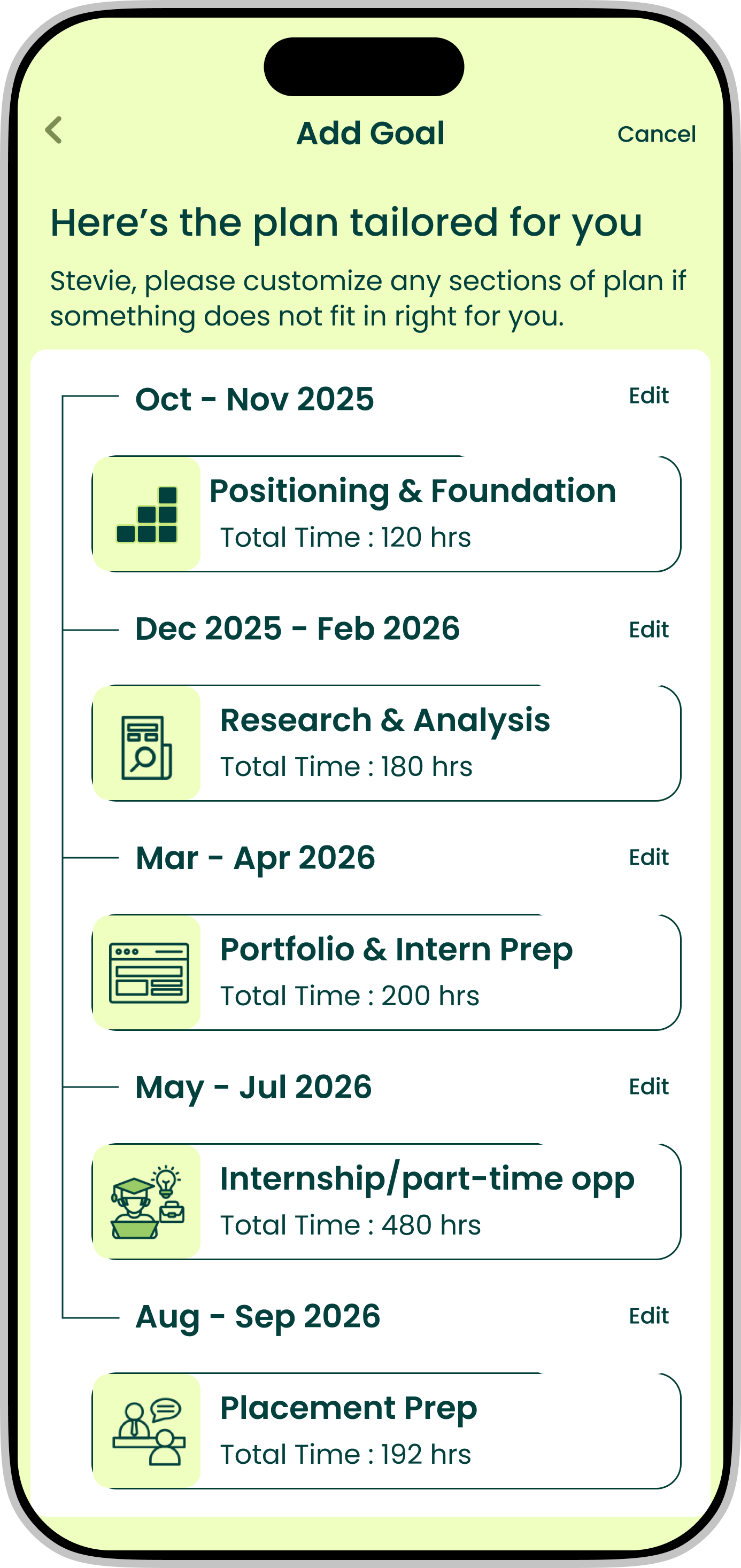
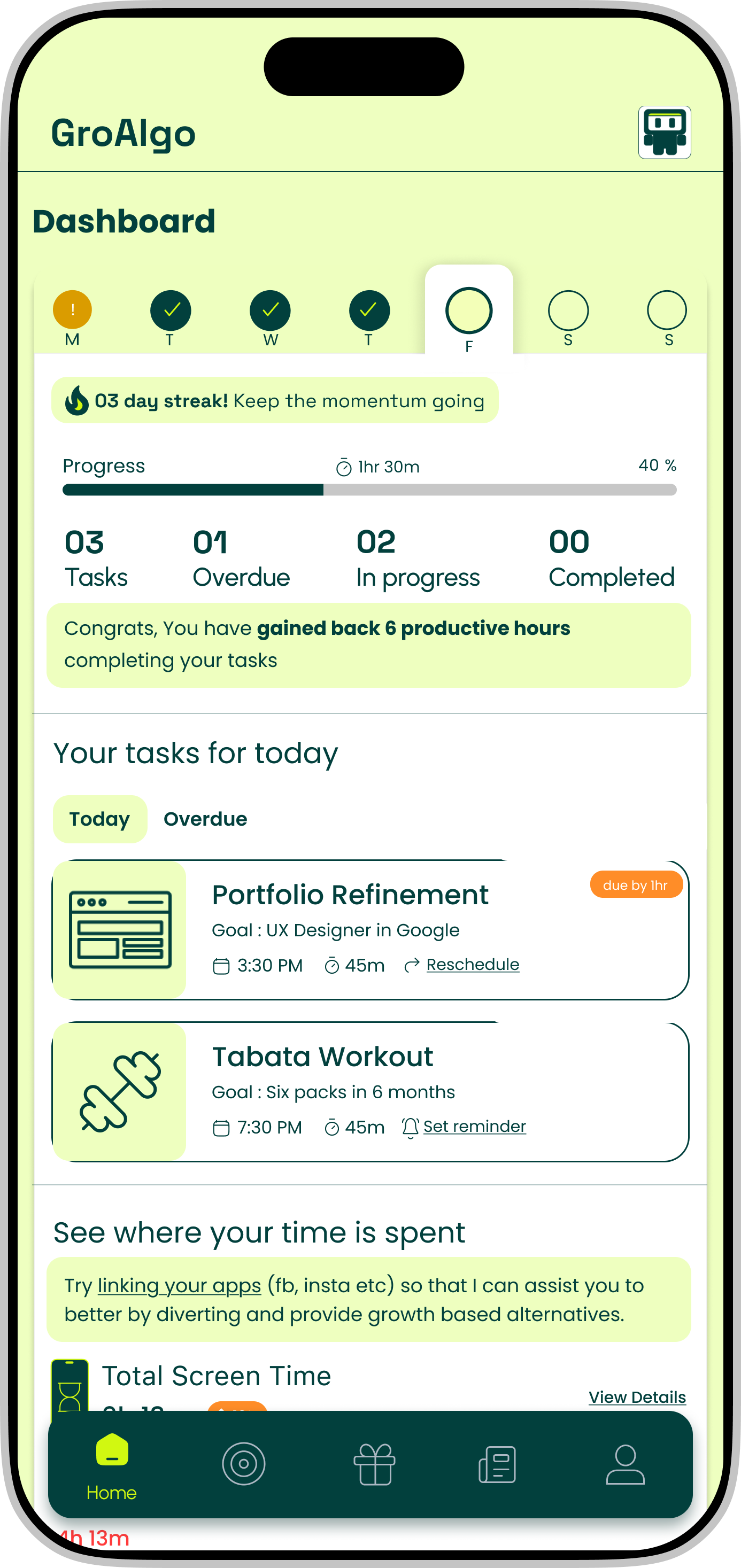
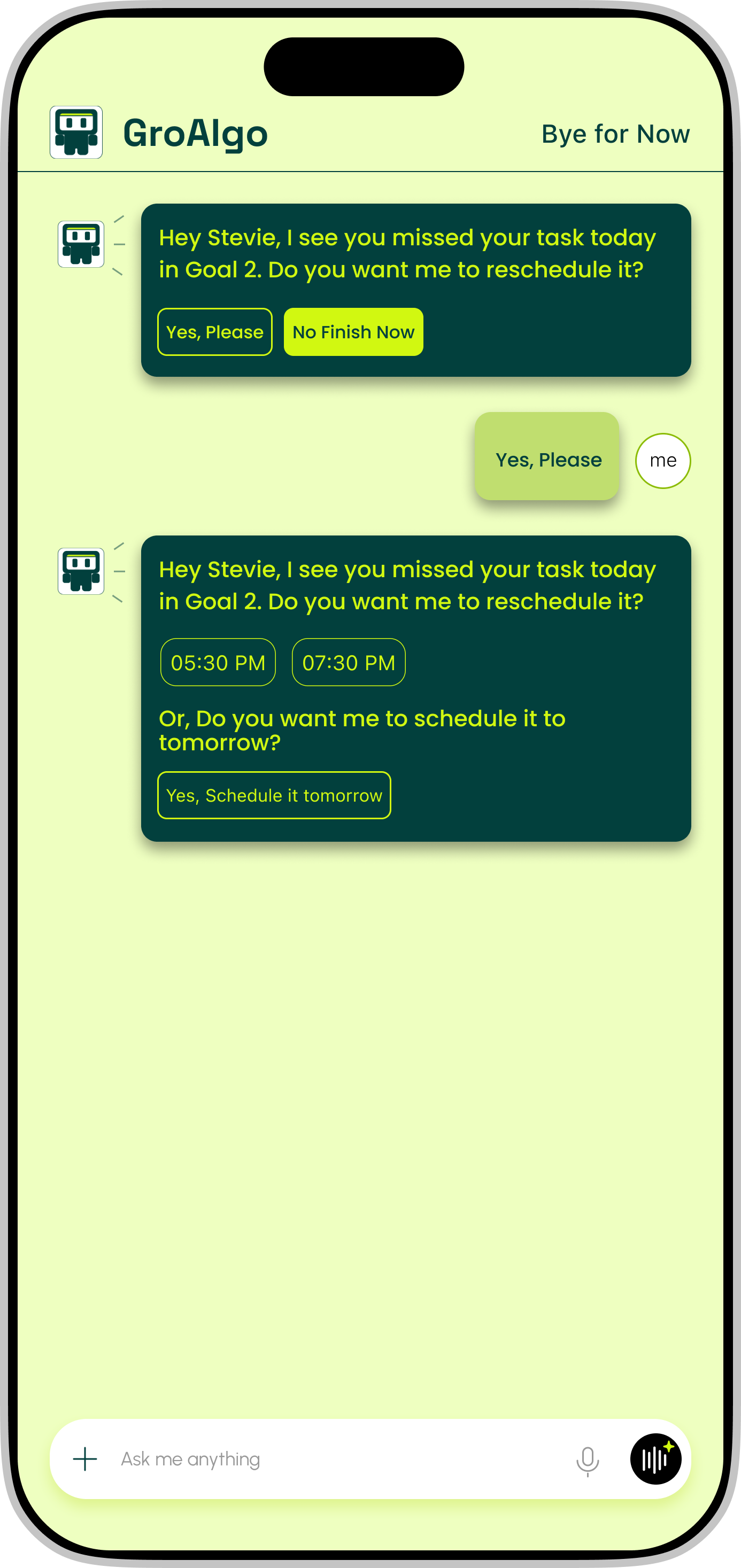
The four features below carry the heaviest conceptual work — the three-screen onboarding, daily dashboard, agentic chat, and out-of-app nudges. The rest of the product lives in the Figma prototype.
The user starts by setting the goal, refines it through a short set of context questions, and lands on a personalized plan — a clear preview of the months ahead, editable on the spot.
Open in Figma →Streak and progress visible at a glance, today’s tasks below, and a “see where your time is spent” surface that invites the user to link the apps that distract them.
Open in Figma →
Reminders, reschedules, and actionable alternatives when a plan slips — so the user never has to restart from zero.
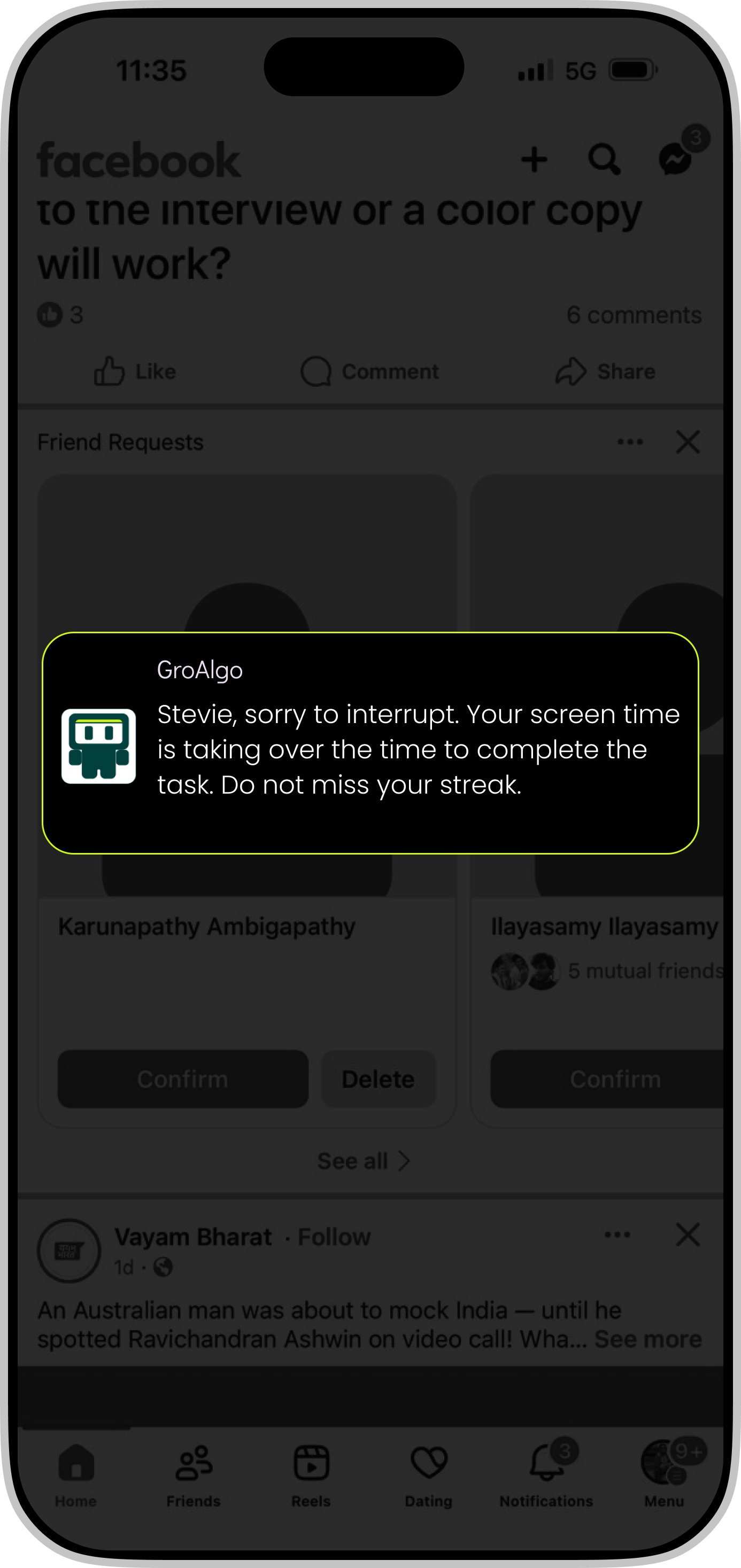
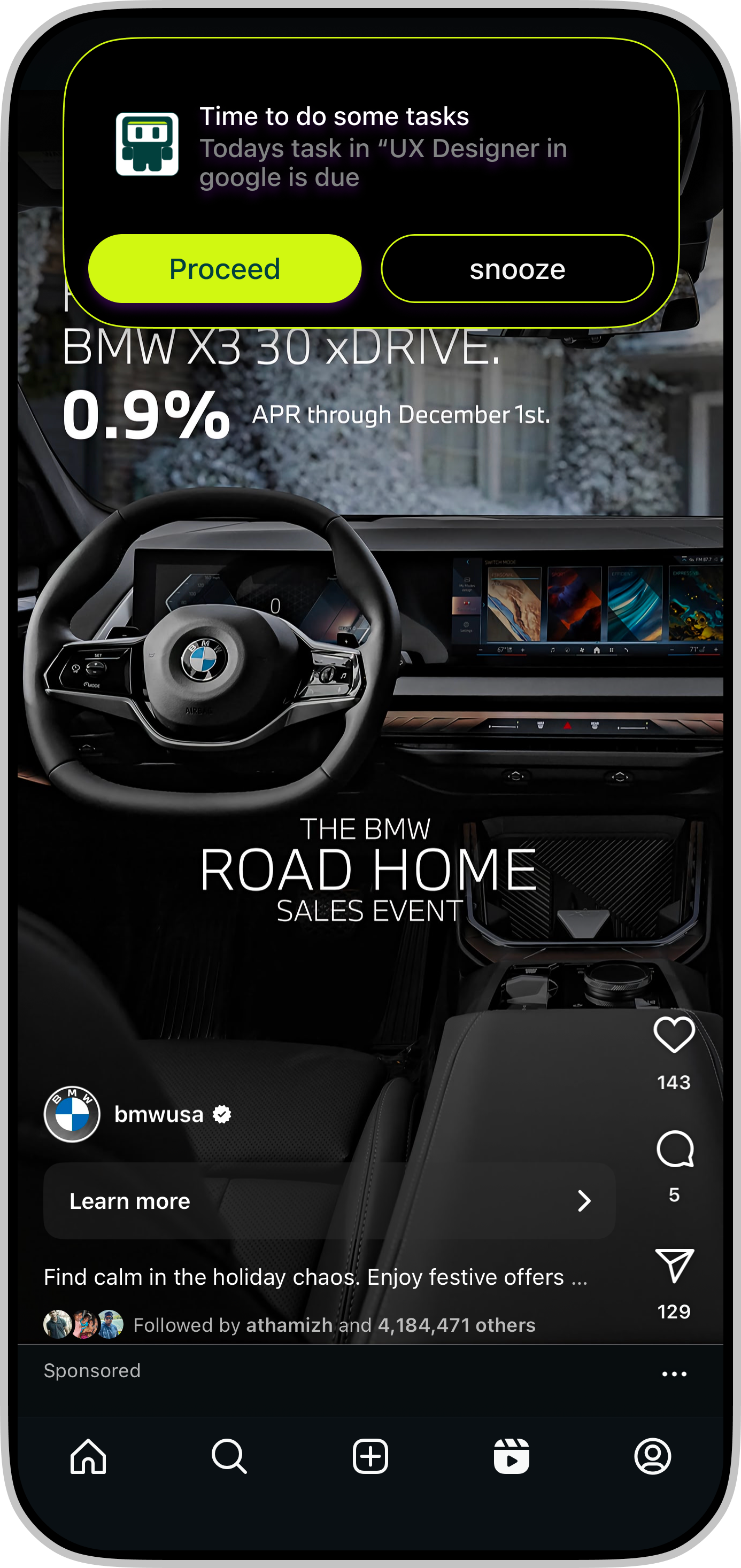
Open in Figma →An overlay on the feed the user is scrolling, a pending-task surface on the lock screen — because distraction doesn’t wait for the user to open GroAlgo.
Open in Figma →
Validation
I tested the prototype with a small group of users to stress-test the hypothesis and flow. The feedback was sharper than I expected — the kind that arrives once you stop defending the design and start listening. Four themes surfaced.
Users felt the distance between install and first useful moment was longer than it should be. The killer three-screen flow worked in concept; in practice, the preamble around it added drag.
Especially around how tasks shift when a day gets disrupted. The static schedule held up in clean test runs, but real life surfaced the gaps quickly — users wanted the system to absorb missed days rather than punish them.
Users wanted rewards tied more tightly to their own demographics and goals. The same badge for “completed a task” landed differently for a 22-year-old finishing a coding tutorial than for a 52-year-old budgeting toward retirement.
Agentic UIs can feel cold, and users wanted GroAlgo to meet them where they actually were — not just where their task list was. The agent voice that read as professional in design felt clinical in use.
Those four themes would be the brief for v2: fewer screens to first value, smarter scheduling, personalized rewards, and an agent that has an emotional register beyond function.
Reflection
GroAlgo was the first project I scoped, designed, and validated end-to-end on my own. The craft lessons are specific; the bigger one was harder to name: the interesting design questions aren’t the ones the brief hands you. They’re the ones you have to write yourself. Three framed this project.
Generational difference is structural, not stylistic. The same product had to honour radically different definitions of progress while feeling like one tool. Personalization became the load-bearing decision, not an afterthought.
Inverting the Hooked Model — same mechanics, opposite outcome — required treating each step as an ethical decision, not a UX recipe. The framework is neutral; what you point it at isn’t.
Validation made it concrete: users didn’t want a polished assistant voice. They wanted a register that acknowledged emotional reality. An agentic UI that meets users where they are is a different problem than one that tracks where their tasks are.
Roadmap
An app competes for attention. An algorithm built into the OS reshapes it. The next step for GroAlgo is moving down a layer — out of the app drawer and into the system itself, where it can quietly redirect every unproductive scroll across every app toward what the user actually wants to grow toward.
The companion stops being a destination. With user permission, it runs at the system layer — observing activity across every app the user grants access to, and intervening only where attention is leaking. No tool to open. No habit to remember.
When the OS detects an unproductive session, the companion surfaces a goal-aligned action inside the app the user is already in. No context switch. The intervention meets people where they are, not where the tool happens to live.
Saving for a house, learning a skill, getting fit, preparing for a career pivot — all under one companion that already knows the user’s patterns. The OS becomes a partner in growth, not just a platform for distraction. That’s the revolution: an algorithm that compounds for you, not against you.
Nobody asked me those questions. I had to notice they were the questions. That’s the work I want more of.